

Oil Search Stalls on the Road to Nowhere
Sri Lanka’s petroleum exploration regulator and energy ministry have calculated the risk-based Mannar Basin potential to be 9 trillion cubic feet for gas and 5 billion barrels of oil. Their conservative estimate is that the gas alone would bring a direct benefit of US$ 200 billion by 2040. Top global oil and gas companies with revenue streams several times […]
Sri Lanka’s petroleum exploration regulator and energy ministry have calculated the risk-based Mannar Basin potential to be 9 trillion cubic feet for gas and 5 billion barrels of oil. Their conservative estimate is that the gas alone would bring a direct benefit of US$ 200 billion by 2040. Top global oil and gas companies with revenue streams several times bigger than Sri Lanka’s GDP, are interested in investing. Sri Lanka stands to earn valuable foreign exchange in the exploration stage alone before even production can commence. To politicians and their cronies (adept at destroying institutional oversight to freely build their wealth at the expense of the public), any attempt to bring in laws and regulations is a threat, and they will destroy institutions and use public fears, paranoia and ignorance to veil their intent.
Geophysicists at Sri Lanka’s petroleum exploration agency pore over data on a computer screen displaying tightly stacked hazy lines. The patterns that these dark, thick and curvy lines form make sense to geophysicists. This is seismic data.
Seismic data replicates a picture of the physical characteristic of an area below the earth’s contours. It’s like a sliced fruit revealing the insides. One slice gives only a two dimensional (2D) view. A few slices of the fruit provides a more complete view of the innards, akin to a three dimensional (3D) view.
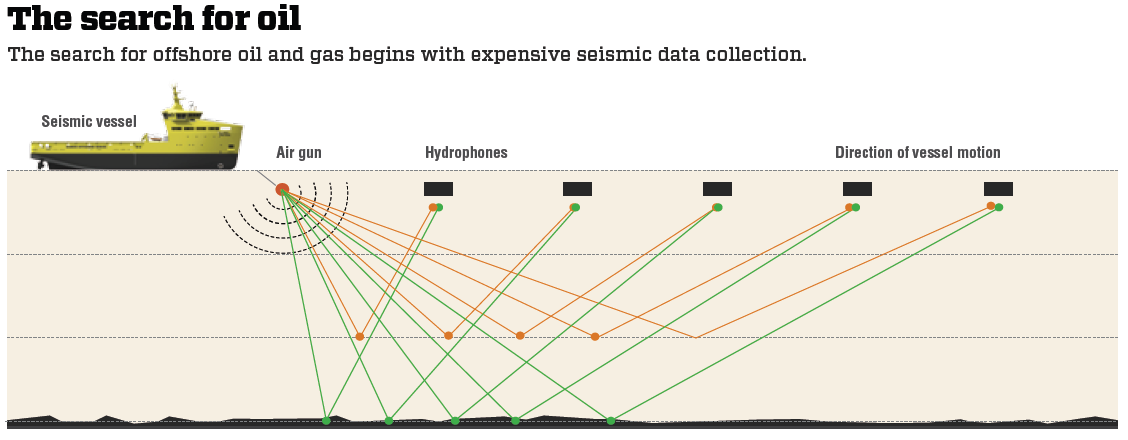
Acquiring 2D and 3D seismic data costs millions of dollars when the contours of the earth’s subsurface being scanned is thousands of metres below sea level. Seismic data is acquired by discharging sound waves (seismic waves) with several air guns submerged below the waterline. These waves are powerful enough to travel through the seabed and depending on how they are discharged bounce off various subsurface layers creating a view of the geography below the seabed. They can reveal subterranean rock formations that experienced geophysicists can identify. Two dimensional data is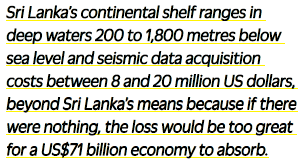 acquired by air guns towed behind a vessel in a straight line, and for 3D views they are laid closer together in a grid formation, enabling geophysicists to construct a three dimensional model of the subterranean landscape several kilometres below the seabed. Enhancing this with gravity and magnetic tests can provide remarkable insights in to geophysical features below the surface. Data identifying subterranean layers several kilometres below the earth’s contours turns back the clock for providing a picture of the earth from millions of years ago. It could provide clues on where petroleum resources can also lie.
They dump dollars in the sea, millions
Sri Lanka’s continental shelf ranges in deep waters 200 to 1,800 metres below sea level and seismic data acquisition costs between 8 and 20 million US dollars, beyond Sri Lanka’s means because if there were nothing, the loss would be too great for a US$71 billion economy to absorb.
But what is the point of all this money and expertise? It’s for the grand prize – Oil.
Cairn India however has discovered there could be gas which has encouraged other international oil majors to also risk millions of dollars, to make billions. Success outweighs failures and international oil companies such as Total and Cairn continue to engage Sri Lanka.
In 2012, French oil major Total SA made a unique gesture. It’s offered the Petroleum Resources Development Secretariat (PRDS – set up in 2005 to regulate exploration activity) via the French embassy in Colombo to undertake a joint study programme to acquire data offshore to the East of the island, where little is known of prospects. Under the joint study model, Total would fund the project and earn the right to be the first to use the new data exclusively for three years, and make a bid for an exploration block. If an agreement is not reached for an exploration license, then Sri Lanka could use the data to call for bids from other oil and gas companies.
“This model is commonly used in other parts of the world. It’s a good opportunity because the project is funded by others and we would own the new data. What is particularly interesting about joint study programmes is that local academics such as geophysicists would be roped into studying the data. This would give us an opportunity to develop local human resources as well,” a PRDS official explained.
Total’s offer coincided with the second exploration bid round launched in 2013 and PRDS officials were optimistic that Total’s entry to Sri Lanka would boost the country’s profile. A paper seeking approval to negotiate a deal with Total was prepared and presented to Cabinet. It got the green light. But nothing happened.
Parallel to the 2013 bid round launch, the PRDS was also in talks with several oil majors to update the seismic data of the Mannar Basin on the West coast.
“We had data that was 20 to 30 years old and these were almost obsolete. We needed new data and we promised prospective bidders that they would have this,” an official of the PRDS said.Top service providers in the global oil and gas industry such as Schlumberger/Western Geco, CGG (a French geophysical service provider), Petroleum Geo Services (Norway), Spectrum (USA), Ion Geophysical (USA) had submitted proposals to PRDS to conduct multi-client data acquisition surveys covering almost the entire offshore territory of Sri Lanka, not just the Mannar Basin.
Unlike, the Total joint study programme proposal, these companies would have the right to sell the data to oil and gas companies interested in exploring, for which Sri Lanka would receive royalties and then own the data outright after specific period of time. The PRDS submitted a proposal seeking Cabinet approval to begin negotiations.
Sri Lanka also committed itself at 2013 oil exploration roadshows in London, Singapore and the US that it would pass legislation to regulate the oil and gas industry and protect investments. The PRDS was set up under the Petroleum Resources Development Act that had not taken into account the possibilities of oil and gas production and industry regulation. “We did not have to reinvent the wheel. We looked at countries with strong laws and regulations and with good track records of delivering petroleum wealth to its citizens. A draft amendment to the Petroleum Resources Development Act was prepared. This got stuck at the Attorney General’s office,” an official said.
 BP, ExxonMobil, Royal Dutch Shell, Eni and Total were among several oil companies expected to bid for blocks at the 2013 bid round. But when bidding closed in December 2013, only Cairn India had submitted a bid for one block in the Mannar Basin and Bonavista Energy of Singapore for two blocks in the Cauvery Basin; an anticlimax for a hyped up campaign.
Officially, PRDS maintained that global oil majors were distracted by Myanmar’s offer for oil exploration, where around 30 oil companies bid for 64 blocks. Bangladesh, like Sri Lanka timed its bid round too close to Myanmar’s bid round but was worst off without a single bid.
“We kept in touch and hosted them several times to our data room in Colombo where their geophysicists would create basin models to understand the potential. Some companies made multiple visits and when we launched the bid round they were quite optimistic,” one official said. The lukewarm response to the bid round, although securing investment commitments worth US$200 million from Cairn India and Bonavista, was a bitter pill. To this day, these bids remain unopened. The PRDS didn’t require an autopsy. It was obvious. Slow strangulation of a public institution by those in power.
“The PRDS came under the Petroleum Resources Development Committee which reported directly to (former) president Mahinda Rajapaksa. There were too many things in the former president’s plate, and certain officials were trying to carve out control over to themselves. We could not keep the promises to prospective bidders of new seismic data and laws and regulations. There was no focus and lack of leadership was the biggest drawback. This is perhaps why the 2013 bid round ended in disappointment,” an official of the PRDS said. Four members of the PRDS shared these views. The PRDS was also swimming against strong bureaucratic currents to formulate a national gas policy with legislation covering both the downstream and upstream oil and gas industry.
Cairn India in 2012 announced two gas reserve discoveries which sparked off global oil industry interest in Sri Lanka. But Sri Lanka was unprepared for this. An oil discovery would have been far more convenient. Oil extraction and distribution is not as complicated as for gas. Natural gas can be liquefied but is an expensive process.
“Oil companies would go to the Arctic looking for oil but not for gas,” a PRDS official said. ”Cairn India’s discoveries were significant and we had to create opportunities for the country. Finalizing an agreement with Cairn India on natural gas would have done wonders for our 2013 bid round. But sadly this did not happen.”
The energy ministry formulated a National Gas Policy with input from the PRDS which like it did with the draft amendments to the Petroleum Resources Development Act, looked at policies of successful countries. The Sri Lanka Carbon Fund of the energy ministry conducted a study on the applications for natural gas.
At low cost, some of CPC’s electricity generation plants could be converted to gas and transport was another sector red-flagged as a ready beneficiary of gas along with industrial heating. Exporting the excess to India was identified as a major opportunity, a PRDS official said. The revenue from both gas fields were estimated at around US$12 billion.
According to the PRDS, a domestic gas pipe network would have cost US$ 1.7 billion to set up.
 Sri Lanka’s energy needs are expected to increase six fold by 2040. Although the previous regime identified coal as a cheaper energy source around this problem, its own energy authority warned that 10-20% of the coal burnt ends up as ash, depositing ‘tonnes of toxic heavy metals in the soil and water table’.
However, the Treasury kept calling for greater oversight over the pricing and gas policy, although lacking the expertise in the gas and oil sector. This was PRDS’s mandate for which it had the expertise. “For some reason, the Treasury kept stalling,” a PRDS official said.
Cairn India’s quarterly financial reports maintain that monetizing and commercialization discussions were a challenge.
PRDS officials had to also battle perceptions and prejudices of public officials in its search for beneficial commercial ties with global oil companies.
The 2013 Cabinet nod for the PRDS to enter into negotiations with French oil giant Total was scuttled by the Treasury.“We heard that the Treasury Secretary did not like the idea of a French company because the west had sided against Sri Lanka at the UNHRC,” a PRDS official said. “Total kept making inquiries for over two years and we were in an embarrassing situation because this was unprofessional behaviour on our part. We could not tell them ‘yes it was going ahead’. We could not tell them ‘no it was not’, either.” This cost Sri Lanka two opportunities. One, it lost an opportunity to raise its profile considerably during the 2013 bid round. Two, it lost an opportunity to acquire seismic data off the East coast. Similarly, the multi-client data acquisition did not progress.
PRDS officials said the former Treasury Secretary Dr.Jayasundera’s policy was to shun oil companies all together, especially from the west, and promote governmentto-government deals. Dr.Jayasundera could not be contacted for comment.
“What we need is proper laws and regulation to safeguard the country’s interests and also guarantee the safety of investments. Oil companies have the expertise and the money. Governments are inefficient in these aspects and are clouded in more secrecy,” a PRDS official said.
For all Iran’s western-phobia (vice-versa) it has a willingness to work with oil majors based in France (Total), Netherlands (Shell), Italy (Eni) and even the US (ExxonMobil and ConocoPhilips) because the demarcation between commercial interests and politics is understood. Iran is planning a major international conference on petroleum exploration hoping to attract the oil majors because the second largest oil producing member of OPEC needs more investment, and the conference will be held this September in, of all places, London, a great ally of the US.
“The previous government comprised a close-knit few and this was a problem in pushing for updated laws and regulations. We could not reach former President Mahinda Rajapaksa even though the PRDS operated under his direct authority. Lalith Weeratunga (head of the Petroleum Resources Development Committee) had trouble getting through to the president and Dr.Jayasundera kept blocking essential decisions every step of the way,” a PRDS official said. “Lalith Weeratunga did manage to get through to president Rajapaksa and in late 2014 we decided to stick with our decisions and push for Cabinet approval on several outstanding matters. Dr.Jayasundera was not happy with this and he sent his resignation from the Petroleum Resources Development Committee. It was an ex-officio position as Secretary of the Treasury, so how he could resign was puzzling to us. We could not do anything however, because the Presidential election was called,” a PRDS official said. The PRDS forecast earnings from oil and gas is US$200 billion by 2040 and is a tempting prize for anyone holding power in the country.
“Individuals were trying to control the industry here and preventing it from becoming a sector regulated by robust laws, good governance and transparency crucial to ensuring people benefitted the most,” a PRDS official said. Elsewhere, countries have taken stock of the value of sound laws and regulations. When Narendra Modi swept into power in India, one of the first things he did was to engage the oil and gas industry. He placed energy on the top of his agenda. Top global players had complained of policy paralysis and delays in India with one player leaving the country. Modi vowed to introduce a new petroleum exploration policy with transparent procedures to woo heavyweights such as Chevron, ExxonMobil and BHP Billiton and Santos. He planned to expedite exploration in blocks already awarded.
A 2013 report prepared by the ministry of energy and the petroleum exploration agency, Petroleum Resources Development Secretariat (PRDS), estimates Sri Lanka’s potential net earnings from offshore gas in the Mannar Basin of US$200 billion by 2040 based on analysis of seismic and other data.
Comparing Sri Lanka’s offshore seismic data with data from across the world of locations with proven oil and natural gas fields, geophysicists since the 1960s have concluded that Sri Lanka has oil and gas potential.
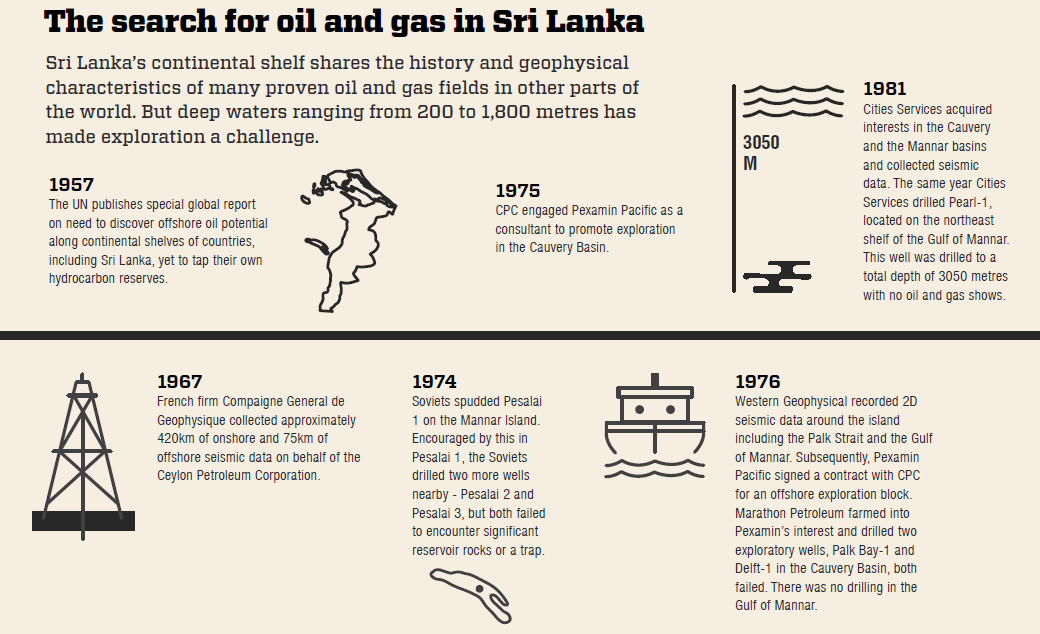
International oil companies have kept an eye on Sri Lanka since the late 1950s (see timeline) because the country’s continental shelf is made up of sedimentary rock. Sedimentary rock is the first clue geophysicists look for. It is saturated with particles of prehistoric plants and animals, and depending on the heat and pressure levels they have been cooking in for millions of years becomes oil or gas.
Between 1957 to 1981 French, Russian and Canadian oil companies have drilled seven exploratory oil wells on land and offshore but no oil and gas was found. Geophysicists learned early on that Sri Lanka’s sedimentary rock formations hugging the northern-west and north-east coastal belt did not have other characteristics for an oil or gas reserve such as a thick volcanic rock layer to naturally trap the hydrocarbon particles in the sedimentary rock which would otherwise escape through the sedimentary rock pores to lower pressures of the sea-level atmosphere.
So the focus shifted offshore.
 Six seismic surveys have been carried out in the Mannar Basin in the West and Cauvery basin in the north before 2001 with Norway’s TGS NOPEC carrying out the last survey. In 2007, Sri Lanka launched its first licensing round and called for bids for six blocks, with two separate blocks offered to the governments of India and China. Neither country has responded to this gesture. Cairn India bid for three of these blocks, ONGC Vaidesh bid for two and Niko Resources (Cyprus) for one block. Cairn India won its bid for one block and the country’s first petroleum resources license was issued. Cairn India (now part of the Vedanta Group listed on the London Stock Exchange) had committed to a minimum investment of US$110 million and signature bonus of US$1 million was paid to the government.
In 2012, Cairn India made two discoveries after drilling four exploratory wells. One reserve is measured at 2 trillion cubic feet and the other 300 billion cubic feet. Sri Lanka was lucky to find natural gas in such a short time.
“The Santos Basin in Brazil is among the biggest oil and gas fields in the world, but oil companies had to drill close to a hundred exploratory wells before they struck oil and today it’s one of the biggest fields in the world,” a geophysicist at the PRDS said. “Cairn India’s gas finds are exciting because it proves the Mannar Basin’s petroleum potential.”
There is more to be excited about.
“Our seismic data shows a thick volcanic rock layer that can be dated 60 to 95 million years ago to the Cretaceous period. Such volcanic rock can act much like natural caps to trap the oil and gas saturated in seismic rock, called a source, underneath. Oil companies struck oil in the Santos Basin only after they drilled below the volcanic layer. We have source rock and caps in Mannar, and we believe there is oil, but we would still have to drill to make sure,” the geophysicist said.
Sri Lanka was in the heart of super continent Gondwanaland 200 million years ago and countries that share this history have found oil and gas including India, Tanzania and Mozambique which made the biggest natural gas find in the century at 100 trillion cubic feet.
Cairn India and the government commenced discussions to monetize the reserves and commence commercial production. At this point, it was expected that production would commence by 2018. The Company had invested US$214 million on exploration activities with around 10% of this spent on Sri Lankan companies for support services, a PRDS report said.
No sooner Cairn India announced two discoveries in 2012, several international oil companies visited Colombo looking for prospects. “Geophysicists from global oil majors such as Exxon Mobil (US$ 346 billion in assets in 2013), Chevron (US$253 billion), BP (US$ 306 billion), Total (US$ 150 billion), Eni (US$ 124 billion) visited the country many times to study our data and also to seek opportunities in the exploration field. Gazprom from Russia, ONGC and around 25 other companies made inquiries from PRDS or visited us in Colombo,” a senior official of the PRDS said.
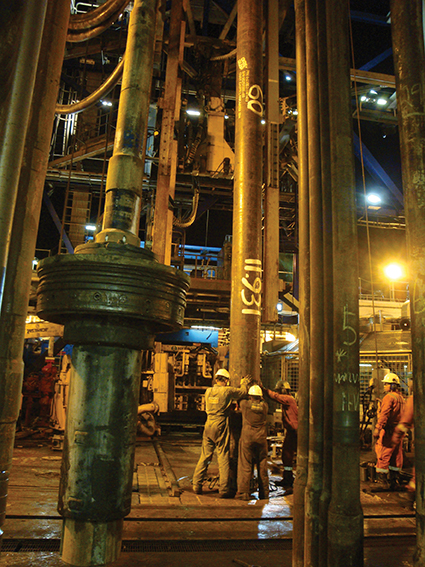
Sri Lanka’s offshore potential oil and gas fields are 200 to 1,800 metres below sea level which makes exploration and production an expensive affair, with costs increasing by US$ 40-50 million more than for drilling in shallower waters. Offshore drilling is twenty times more costlier than in land. This is why Sri Lanka must deal professionally and transparently with probably the only ones with enough money to risk in the search for gas and oil – the multinational petroleum majors.
But PRDS staff point out that oil prices tend to follow a cycle and that current low prices would not last indefinitely and that commercializing our gas reserves should be a matter of priority.
“Taking the natural gas industry forward is crucial, because it would attract more investors to the search for oil. The national gas policy, Total joint study programme, unopened bids received by Cairn India and Bonavista, multi-client data acquisition programmes and amendments to the Act have all been presented to the Cabinet of the previous regime. These must be reviewed by the present government and taken forward in a transparent manner for the sake of all the people of this country,” a PRDS official said.
Oil and gas companies went into Nigeria and enriched themselves and its rulers and cronies at the expense of the people. They are learning the hard way because no one wins at the end of the day and now Nigeria is scrambling to establish laws and regulations and the people and oil companies themselves are now asking for these.
Nigeria is often cited as a bad example. Without laws and regulations and public oversight in parliament, Sri Lanka runs the risk of going down the same road. The regulator has everything in place to protect the interests of the Sri Lankan people and the investors. What has been lacking is political leadership to introduce and enforce laws that would guarantee transparency, good governance and fairness to all.